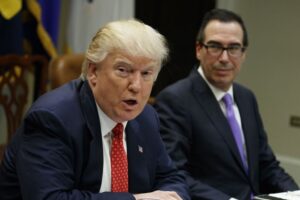

President Donald Trump announced a new executive order to impose a 100 percent tariff on all films produced outside the United States that are imported into the country. Trump framed the policy as a much needed protection for America’s film industry, accusing foreign countries of “stealing” U.S. movie production.
When people think of the film industry, they imagine Hollywood red carpets or blockbuster studios in Atlanta. Rarely do they think about farmers leasing land for a period drama, or a rural main street transformed into a movie backdrop. Yet for North Carolina, film and content production is not only about storytelling—it’s about job creation, small-business revenue, and revitalizing communities that have been left behind.
Rebecca Mills, Executive Director of the Piedmont Triad Film Commission, travels the region to remind community leaders that this industry is largely blue-collar. Every production hires electricians, carpenters, caterers, drivers, and costume designers to work. A single project might mean hundreds of jobs and millions in spending with local vendors. That is an economic jolt few industries can deliver so quickly.
The demand for content has jumped dramatically in the past decade. Streaming platforms like Netflix, Amazon, Disney+, and Hulu are churning out original shows and films at a breakneck pace. Social media platforms—YouTube, TikTok, Instagram—have also fueled a voracious demand for high-quality, short-form content. This isn’t a passing fad. Consumers now expect a steady flow of new stories, narratives, and influential voices.
That relentless demand means production capacity must be extended beyond Los Angeles or New York. North Carolina is well positioned to fill that need. We offer diverse landscapes, lower costs, and proximity to major talent markets on the East Coast. But if we fail to support our existing film community and invest in critical infrastructure, we’ll watch states like Georgia, Louisiana, and even Kentucky continue to scoop up projects that could easily land here.
Charlotte and Wilmington have long been our marquee production hubs. But the real opportunity for North Carolina lies in its small towns and rural counties. Our diverse landscapes—rolling farmland, historic courthouses, tobacco barns, and factory mills—are ready-made sets. These locations give producers authenticity they can’t fake on a backlot.
More importantly, productions in rural areas spread money to places where economic development opportunities are scarce. Hotels fill up, restaurants serve new customers, and vendors from hardware to dry cleaning see a lift. Carpenters and electricians get steady work building sets. A rural county that hasn’t seen a new factory in decades can suddenly experience a million-dollar injection from a single film.
Film tourism also dovetails with our state’s branding as a place of natural beauty, heritage, and creativity. Every time a location appears on screen, it becomes free advertising that money can’t buy.
North Carolina’s film incentive program is competitive, but its structure unintentionally sidelines rural areas. Current thresholds often require productions to spend several million dollars to qualify. The current policy works in Charlotte or Wilmington, but it discourages smaller independent projects that could boost places like Surry, Davidson, or Randolph counties.
Rural economic developers need to start treating content production as real economic development, not an afterthought. The world runs on storytelling — film, digital media, podcasts, streaming shows, even short-form social content — and most rural communities are sitting on gold mines of scenery, character, and culture that never get shown to the world.
The Piedmont Triad is home to institutions like the UNC School of the Arts, which trains world-class talent in filmmaking, animation, and design. But without enough productions landing here, graduates leave for Atlanta, New York, or Los Angeles. Strengthening and supporting our regional film commissions can keep that talent home. That means rural crews can build careers without uprooting their families, and small businesses can position themselves as long-term industry partners.
Content production doesn’t stop with movies. Commercials, music videos, live broadcasts, and social media campaigns are all part of today’s ecosystem. Each requires the same mix of locations, crews, and vendors. If North Carolina builds capacity for this wider spectrum of production, we create year-round opportunities instead of depending only on big-budget films.
Just look at Mr Beast in Greenville. He built one of the world’s largest YouTube empires from a small college town, hiring local talent, building studios, and putting an entire community on the global map. That’s not Hollywood money — that’s creative economy money, born from vision, consistency, and community support.
The Piedmont Triad Film Commission, like others across the state, operates with a fraction of the funding it once had. If we’re serious about film as an economic driver, cities and counties must reinvest in the organizations that make deals happen. Rural leaders must modernize their corporate recruitment strategy with an eye toward content inclusion. And all communities must recognize that film isn’t just art—it’s economic development.
Algenon Cash is a nationally recognized speaker and the managing director of Wharton Gladden & Company, an investment banking firm.Reach him at alc@whartongladden.com