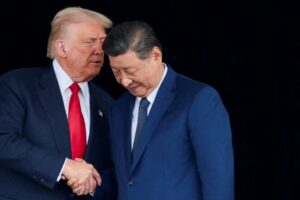

Trump GOP Dominance is no longer a theory. It is the defining reality of modern Republican politics.
President Donald Trump has reached a level of influence within the Republican Party that few political figures in American history have achieved. His endorsements carry enormous weight. His criticism can derail campaigns. And increasingly, Republican incumbents are learning that opposing Trump can be politically fatal.
Just ask Senator Bill Cassidy or Representative Thomas Massie. Both built reputations around independence, fiscal conservatism, and a willingness to challenge party leadership when they believed it was necessary. Yet in today’s Republican Party, ideological credentials and years of service may matter less than loyalty to Trump.
Nowhere is that dynamic more visible than in Texas.
As the Republican primary battle unfolds, Attorney General Ken Paxton has emerged as another test of Trump’s political power. If Paxton secures victory, it will reinforce the growing perception that Trump’s endorsement remains one of the most powerful forces in Republican politics.
Yet Republicans should also consider the broader implications.
Winning a primary and winning a general election are often two very different challenges.
Primary voters tend to be more ideological, more engaged, and more partisan than the broader electorate. General elections require candidates to appeal not only to their party’s base but also to independents, moderates, suburban voters, and those who may not closely follow politics at all.
This creates a potential paradox for Republicans.
The stronger Trump GOP dominance becomes inside the party, the more difficult it may become for some candidates to build broader coalitions outside the party. Candidates who excel at demonstrating loyalty to Trump may find it harder to connect with voters primarily concerned about housing affordability, inflation, healthcare costs, wages, public safety, or the national debt.
Democrats are certainly paying attention.
In some races, Democratic strategists may quietly prefer facing candidates whose campaigns are built largely around Trump loyalty rather than local issues and governance. Such candidates can energize the Republican base while simultaneously motivating Democratic turnout and potentially alienating swing voters.
The Texas race illustrates another concern. If Republicans are forced to spend heavily defending seats that would normally be considered safe, resources could be diverted away from key battleground contests. Here in North Carolina, for example, additional spending in Texas could limit resources available to candidates such as Michael Whatley in a highly competitive Senate race.
At the same time, Democrats should avoid assuming these dynamics automatically work in their favor. Many voters remain frustrated with Democratic leadership on issues including inflation, immigration, crime, and cultural debates. Public dissatisfaction remains a challenge for both parties.
What America is witnessing may be something larger than a Republican story or a Democratic story.
Both parties increasingly appear focused on emotional activation rather than broad persuasion. Mobilizing loyal supporters has become easier than expanding coalitions. Generating outrage often produces faster political returns than building consensus.
That strategy can be effective for a time.
But successful governing coalitions are rarely built on activation alone. Eventually, voters begin asking harder questions about results, leadership, and solutions.
And that is where the next phase of American politics may be decided.
Related Insights
- Trump Visits China to Meet with Xi Jinping: A Conversation with Historian John Hood
- Inside North Carolina Politics: What the Primaries Reveal About Midterm Elections
- Tariffs, Inflation, and the U.S. Economy | A Conversation with Economist Roy Cordato